













ASK HAVWOODS | ADVICE FROM OUR WOOD EXPERTS
Useful information & common questions answered by our experts
With over fifty years' experience working with wood, our knowledgable experts know the questions that come up when choosing, specifying, installing and caring for wood flooring and surfaces.
In our FAQs and information pages, we share straightforward advice and expert answers to some of the most common questions, helping you understand everything from timber characteristics, patterns and finishes to installation, certification, maintenance and technical information.
Simply scroll through this page, use the search function to find information or get in touch to speak directly with with our expert, friendly team.
Frequently Asked Questions
About Wood Flooring
Engineered wood flooring is made from two or more layers of wood, bonded together in a carefully engineered construction to create a more stable flooring material than solid timber.
Engineered wood flooring offers a number of benefits, including greater stability, compatibility with underfloor heating, increased design flexibility and a wide choice of colours, finishes and formats. It combines these practical advantages with the natural beauty of real timber, using a genuine wood surface layer over multiple supporting layers to create a floor that responds more effectively to changes in temperature and humidity than traditional solid wood flooring.
Oil penetrates deep into the timber and brings out the true beauty of both the colour and grain as well as providing protection for the floor. In addition to providing a natural look, oiled floors lend themselves to being spot repaired in the event of surface damage.
Most oiled floors require an additional coat of oil or Hardwax Oil, a mixture of sunflower, soybean and thistle oil, carnauba and candelilla wax after installation. This is micro-porous, water-repellent, dirt-, wear-, and stain-resistant against wine, beer, cola, coffee, tea, fruit juices and milk; it will not crack, flake, peel or blister.
Lacquer is normally a polyurethane coating which is applied to the surface of a wooden floor by brush or roller. The polyurethane covers the pores of the wood and forms a hard, resilient coating which protects the timber from dirt and moisture ingress. A good quality lacquer will protect a timber floor for anything from 12 months to 6 years, depending upon the amount of foot traffic.
Floating floors with a click system joint between planks can be laid without bonding them to the sub-floor. These floors can be uplifted and re-laid several times. Nearly all Havwoods floors can be sanded and refinished to prolong their life and change their appearance, if desired, so the floor doesn’t need replacing when you want to redecorate – something which is unique to wooden floors.
This can vary depending on the specification of your product and whether the product is being used in a residential or commercial setting. Typical residential warranties are between 10 and 20 years.
A solid wooden floor is milled from a single piece of wood and is uniform throughout. An engineered floor has a hardwood top layer with cross-laminated layers of timber beneath to add structural stability. This reduces movement and increases stability under exposure to varying temperature and humidity in the environment.
Installation
As a general rule, Havwoods do not recommend the use of solid wood over underfloor heating. The majority of engineered boards are, however, perfectly suited to use with underfloor heating; this is particularly true of those with an oak lamella and less likely to be so for ones using exotic woods. Always check with Havwoods before specifying any wood floor for use with underfloor heating.
A floating floor installation is one where the planks are attached to each other instead of to the subfloor over which it is being laid. It is a fast, relatively easy method of fixing which allows some room for movement and expansion given changes in humidity; the floor can be removed easily too, making it ideal for commercial applications where the flooring is more likely to be changed within the foreseeable future. Floating installations are usually associated with the fitting of engineered timber floors but, in fact, solid timber boards can also be laid floating over a suitable subfloor providing a damp-proof membrane is laid and Elastilon employed.
Generally, we recommend that a competent professional installer is appointed to install Havwoods floors but for those who wish to install their flooring themselves, we are happy to give guidance on how to achieve a successful installation.
Havwoods have our own academy for the education and training of installers. The details of Havwoods Academy trained installers can be found here.
Wood is a natural material which passively changes its moisture content to reach equilibrium with its environment (hygroscopy). At times of the year where humidity is higher, wooden floors will take on moisture from the air and this causes some expansion. Equally, when humidity decreases, the floor will contract slightly The expansion gap allows for this expansion to occur without creating any tension in the floor from the wood pushing against walls, door frames, pipes etc.
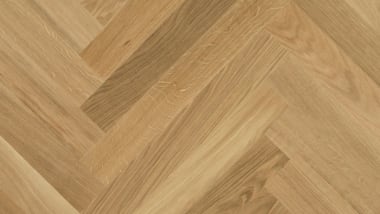
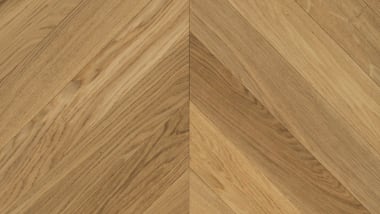
The area(s) of installation will dictate the wastage on any installation, with small areas requiring more wastage than open spaces. For planks we typically advise on 8-12% wastage and patterned floors, such as herringbone or chevron, may need 15-20% wastage. Always consult with the installer for accurate wastage calculations.
Wood is a natural material and each piece of each tree will vary in colour and grain structure. Colour variation is dictated by the age, location, exposure, soil pH and multiple other factors during the growth of the tree.
The order quantity will be the net measure of the areas where the product is to be installed plus the wastage allowance (see above).
The click lock system involves planks that are designed to lock together without the need for glue or nails. Each plank has a grooved edge that fits into the corresponding groove of the adjacent plank. When these planks are angled and pressed down, they lock securely, creating a tight seal that minimises gaps and movement.
Care and Maintenance
Oiled wood floors are very easy to care for. For everyday cleaning to remove dust or loose debris a broom, vacuum cleaner or dry mop is all that is required. For more thorough cleaning, damp mop using a diluted oiled wood floor cleaner. In public places where the footfall is greater, oiled wood floors may be damp mopped on a daily basis and should be treated regularly with a maintenance wax. This may be applied to the most heavily used areas or to the whole floor, spreading it with an electric, single-disc buffing machine with a beige pad. Maintenance wax need only be applied to residential flooring when the wood begins to look a little lifeless.
Read more about how to care for engineered wood flooring.
A properly installed and maintained wooden floor will last for many years (and decades). Havwoods offer varying specifications of product which have different designed lifespans.
Wooden floors contribute to a healthy living environment for all of the family, including pets. It is important to keep pet claws trimmed to reduce any abrasion that these can cause. Maintenance products can be applied to all of our floors to reduce the appearance of minor scratches over time.
All Havwoods floors are tested for stain and spillage resistance When floors are being installed into commercial spaces or busy kitchens, it is often a good idea to apply maintenance products soon after installation to ensure that the surface finish is maintained in these more demanding areas.
Day-to-day cleaning involves sweeping your floor and cleaning with a spray-mop and the correct cleaning solution for the surface finish. Periodic maintenance can be carried out on all floors through the application of a maintenance product, such as a refresher for lacquered floors or Liquid Wax Cleaner for UV oil, natural oil and hard-wax oil finishes.
Read about cleaning and maintenance of UV oiled floors.
Dents and scratches may occur over time these can be fixed with the application of maintenance products or easy to use repair kits.
The vast majority of Havwoods floors can be sanded and refinished multiple times over their lifetime. Each time a floor is sanded, the appearance can be tailored to fit the decoration scheme of the room/area where the floor is installed.